Portuguese and Spanish for Safeguards
I started learning Portuguese nearly 10 years ago and have been fortunate enough to live in both Mozambique and Brazil. As a result, I felt quite confident in my day-to-day ability to navigate life in this beautiful language. My first time working in Portuguese, however, I realized I fundamentally lacked the vocabulary to communicate ideas that I found second-nature in English.
I remember one day, sitting across from regulators in Mozambique, who graciously accepted a meeting in English to discuss new, upcoming biodiversity offset regulations. As we began the meeting, one of the junior government members asked us what biodiversity offsets were. Thinking he just needed a brief explanation, I began, but he immediately intervened, simply asking for the translation. I sat there a bit flat-footed, quickly typing into Google Translate, which spat back “contrabalanços de biodiversidade.” Interestingly, this is exactly what the legislation in Mozambique used, but it’s actually not the standard term in the IFC Performance Standards. I later found out working in Brazil that the standard term there is “compensação.” This moment showed me that not all Portuguese is the same, especially when it comes to technical jargon.
Source of Truth
Luckily, there is actually a source of truth out there. The IFC has generously translated its Performance Standards into multiple languages, including Portuguese and Spanish. While I could have worked through each side-by-side with English to try to learn the vocabulary, I decided to rely on a tried-and-true method: Anki Flashcards.
Anki is a free program for computers and phones that allows you to build digital flashcards. It works on the principles of active recall (forcing you to remember, which is much more effective than passive review) with a built-in algorithm for spaced repetition. Basically, as you study a card and tell Anki how easy or hard it was, the system automatically shows the harder cards more frequently. I’ve found this to be a really effective tool for building vocabulary, especially when filling time instead of doomscrolling or checking social media.
The AI-Powered Anki Deck Build
To build the Anki Deck, I decided to leverage AI. I used Anthropic’s Claude model to generate a key list of “technical terms” from the IFC Performance Standards. I cross-checked this with Gemini because I’ve found some models perform these specific extraction and summarization tasks better than others.
Once I had a working list of terms I was satisfied with, I asked Claude to compare the official English, Spanish, and Portuguese translations and extract the corresponding terms. I used these to build a table of about 85 English-Spanish-Portuguese technical terms.
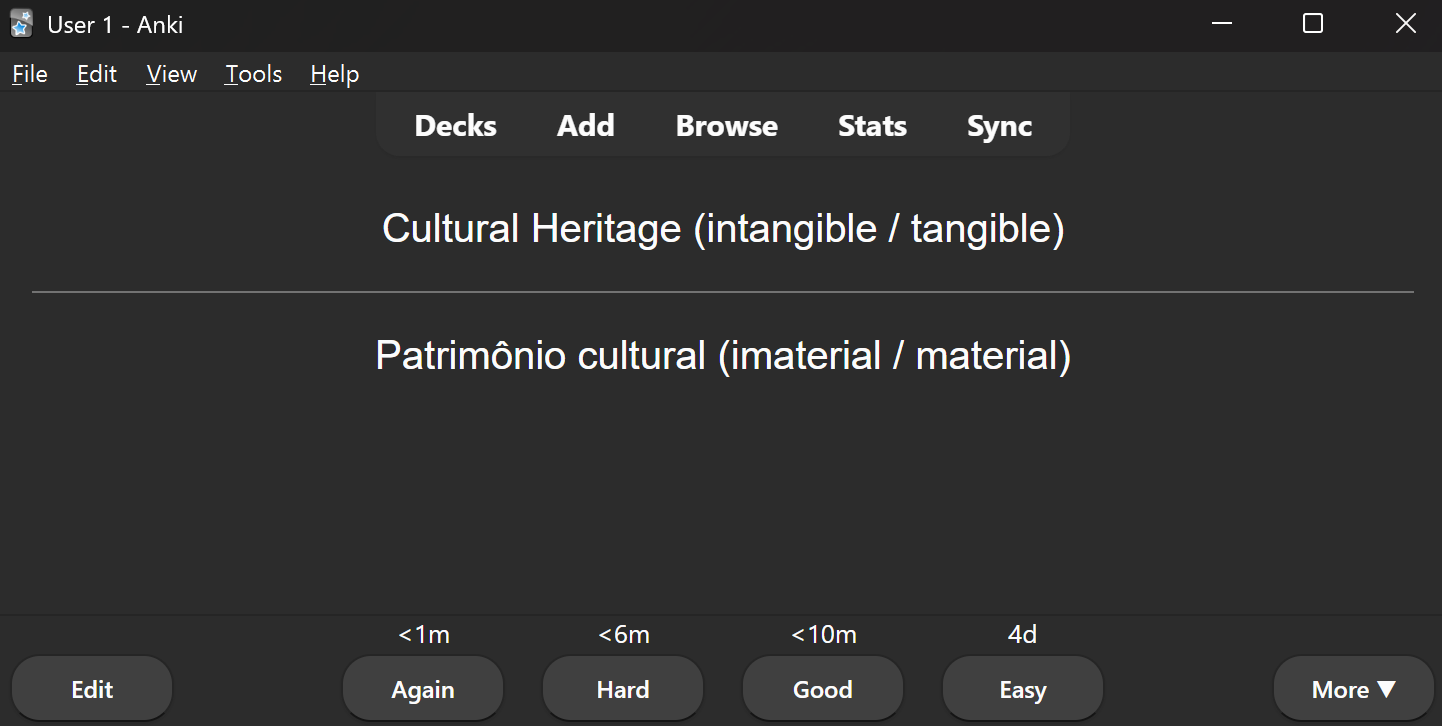
Anki’s EN-PT Deck
After a quick verification, I separated these into individual English-Spanish and English-Portuguese tables and saved them as a CSV file. Using Anki’s desktop app, I simply created a new deck and imported the CSV—and voilà! Two decks to help me learn these crucial technical terms in their corresponding languages. Finally, I augmented the decks with a few terms I knew were important but didn't appear in the initial list, such as “Área Tombada” (used for protected heritage) or various terms used for “grievance.”
I hope you find these tools useful! I’ve uploaded both the Anki decks, which can be downloaded and imported directly onto your phone, as well as a corresponding Excel sheet in case you want to customize it yourself. Please send me a note if you ID terms it’s missing and I’ll keep it updated for everyone!